We’ve been watching the shift happen in real time and it is one of those things that feels optional until suddenly it’s not.
If you’ve noticed your website traffic looking a little differently recently, or you keep hearing terms like “AI Overviews” or “GEO” and it all conjures up thoughts of The Matrix, then this article is for you. (Neo and GEO sound similar, after all)
Google isn’t just a list of blue links anymore
For as long as many of us can remember, Google has worked the same way. You type something into a search field and it spits out a list of websites to choose from. You click one, or twenty, then find what you’re looking for. Fortunately, or unfortunately, that’s not really how Google works in the era of Artificial Intelligence, or AI.
Google now uses AI to read through content from across the web (think millions of websites, Reddit, Wikipedia, trusted reference databases, blogs, etc) and generates a summary for the user at the top of the page. All before they ever scroll to a single blue website link. These are called AI Overviews and they are showing up more prevalently in everyday searches.
Why does that matter for your business? If someone searches “what should I look for in a commercial general contractor” or “how do I choose an engineering firm for a large project” they likely get a complete answer before they ever see any website at all. If your firm is not being referenced in that AI generated response, then you are likely not in the conversation.
According to a study cited by Search Engine Land, 75% of Google AI Overview links come from sites already ranking in the top 10 to 12 organic search results. So if your website is not performing well already in traditional SEO and search, then it’s even less likely to show up in Google’s AI generated answers.
What this really tells us is that the foundation of search has not changed. Strong, consistent SEO is still what works. And AI Overviews are just raising the bar for what happens next.
What is GEO and Why is Everyone Talking About It
GEO stands for Generative Engine Optimization. Yet another tech acronym, but this one is well worth understanding.
Traditional SEO was about helping Google understand what your website or web page was about so it could rank you in search results. Now GEO is about making sure AI search tools can understand who you are, what you actually do and why you’re a credible source worth showing.
Engineering, construction, B2B and professional service clients are not impulse buyers or decision-makers. These clients are doing the necessary research before they ever reach out. They are vetting, comparing and processing information faster than ever. And much of that process is now shaped by AI before they ever land on your website. That is where we want your business showing up.
How AI Determines What to Surface
The information AI reveals to users is not random, it’s looking for specific things.
It wants content that actually answers searchers’ questions clearly, without a lot of fluff or vague language. It wants to ensure you know what you are talking about, which means things like well written service descriptions, real case studies and consistent messaging on your site. AI wants a technically clean and easy to crawl website. And it pays attention to whether the information on your website lines up with what your Google Business Profile, LinkedIn and other listings say about you.
Basically it is looking for the same things a smart and skeptical human would look for when trying to figure out whether a company is real and trustworthy.
What We See When We Audit Websites
We tend to see the same things come up over and over when we dig into a website built without a content strategy behind it.
Vague service pages (or sometimes no service pages), generic copy that could apply to any company in any city, no proof of work, no outcomes and nothing that communicates the firm’s expertise. On the technical side, issues like slow load times, missing metadata and confusing site structure make it hard for search engines to understand what the business even does. This translates to simultaneously making it difficult for humans to understand what the business does.
None of that is a knock on the businesses themselves as more often than not, the website just was not built with those things in mind. But it is a real problem now in comparison to two or three years ago.
The businesses that will succeed in AI search are not the ones finding clever workarounds or gaming the system. They are the ones who have invested in a website that reflects who they are, clearly communicates and gives both people and AI something that’s worth paying attention to.
This has always been good website strategy, AI has just made it all the more urgent.
Where to Start
To start, search for your own business the way a potential client would and look at what shows up in the AI section at the top. Is your firm being referenced? Is the information accurate? Does your website actually answer the questions your ideal clients are asking?
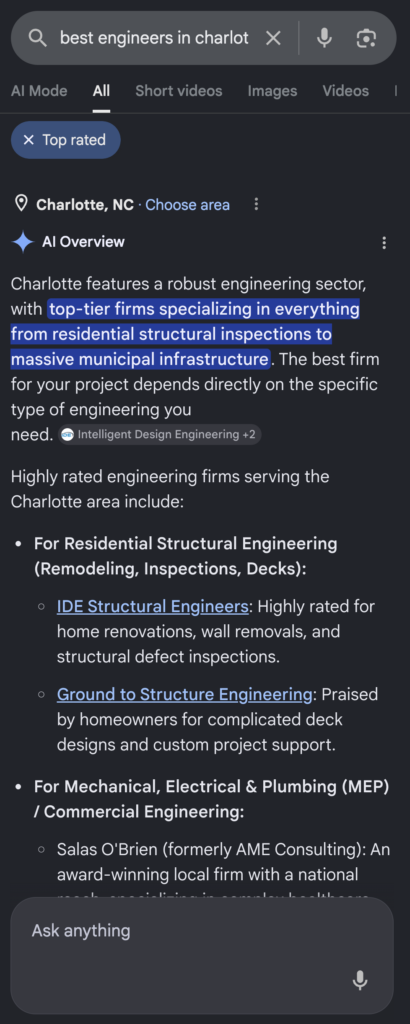
If the answer is confusing or you aren’t showing up, that is your starting point.
This is a big part of why we built our SEO and GEO work around a comprehensive website audit first before we make recommendations. You’ve got to know what you’re working with before you can fix it and decide on a path forward.
At M|J Creative, we work with B2B, architecture, construction and professional services firms who want their website to perform on auto-pilot. If you’d like to understand where you stand, take the first step with a website audit.